Amazing Stories Centenary
Science fiction has been traced back as far as Gilgamesh and the term was first used in 1851. However, science fiction as we recognise it today first emerged in mass market magazines in the late nineteenth and early twentieth centuries in a context of rapid industrialisation, printing innovations, and increasing literacy.
The first magazine to solely publish science fiction was Amazing Stories. The first issue was dated April 1926, exactly a century ago. With the advent of a purely science fiction magazine in Amazing Stories, the genre was allowed space to develop a niche audience, to encourage author specialisation, and to formalise the specific tropes that we associate with science fiction such as aliens, robots, and space flight.
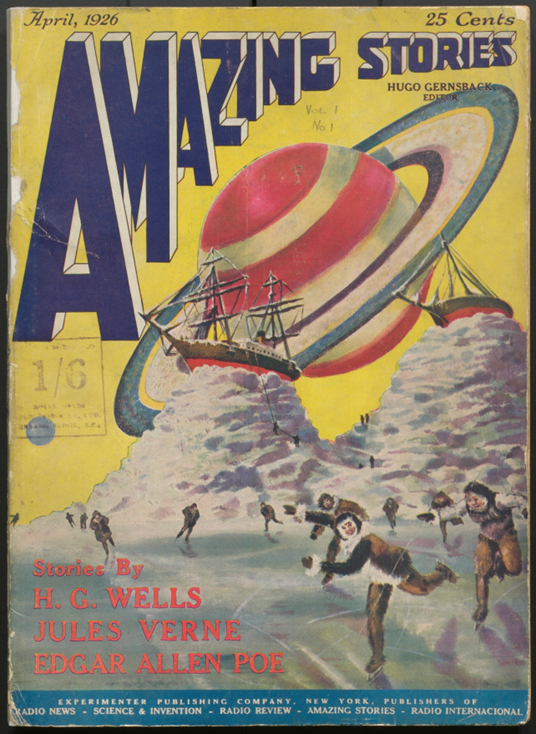
The cover of the first issue shows figures ice skating beneath a yellow sky dominated by a looming ringed planet. The scene is taken from one of the stories contained the magazine, the first part of Jules Verne’s Off on a Comet—or Hector Servadac first published in 1877. The artist for the cover, Frank R. Paul, became synonymous with early science fiction magazines and was recognised for his large planetary vistas and futuristic cityscapes.
The editorial in the issue announced itself as ‘A New Sort of Magazine’ in which ‘Scientifiction’ stories would ‘hold forth exclusively.’ The editor, Hugo Gernsback described the genre as ‘a charming romance intermingled with scientific fact and prophetic vision.’ For Gernsback the engaging story allowed readers to absorb science without effort and to get excited about the world to come.
As with the first issue, the early issues of Amazing Stories contained reprints of nineteenth and early twentieth century authors such as Edgar Allan Poe, H. G. Wells, and Jules Verne. Reprints allowed Gernsback to set the standard for the genre and in doing so formed a canon for others to follow. In a few months the magazine had 10, 000 readers. Gernsback fostered a sense of community with these new readers by starting a letters column and running competitions. The first competition in December 1926 was won by Clare Winger Harris, the first regular woman writer for the science fiction magazines, for a story based on a cover by Frank R. Paul.
Though Gernsback aimed for there to be a balance between adventure and science, the readers desire for escape dictated the balance away from science to entertainment. Gernsback published the space operas of Doc E. E. Smith and the first Buck Rogers story by Philip Francis Nowlan, which would go on to be a popular comic strip published in American newspapers. These stories have tended to tarnish Gernsback’s reputation in the eyes of scholars and critics. The author and critic Brian W. Aldiss called Gernsback ‘one of the worst disasters ever to hit the science fiction field.’ However, fans of the genre disagree: the highest prize for science fiction, the Hugos, are named after Gernsback and given out each year at the World Science Fiction Convention.
Gernsback became bankrupt in 1929 and stepped down as editor of Amazing Stories. Amazing continued but in the 1930s was joined by a host of other science fiction magazines including Gernsback’s own Science Wonder Stories. By this point Amazing Stories had built a market, a canon, and an active readership for the genre. That nascent culture, born in 1926, is till going strong a hundred years later. Science fiction today is a truly global and multimedia genre, consumed by millions of people across the globe. Here’s wishing science fiction a happy centenary and all the best for the next 100 years!
Amazing Conservation
At the University of Liverpool we have a copy of the first issue of Amazing Stories as well as a near full run of the magazine. In 2025 we contracted a conservator, Sharon Oldale, to repair the first issue. The conservator cleaned and repaired the cover using acid-free lens tissue and Japanese paper. The corroded staples were removed and replaced with linen stiches and the cover reattached with wheat starch paste.
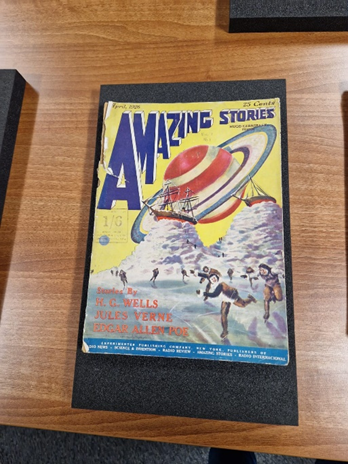

Above are photographs of the copy of the first issue of Amazing Stories before and after conservation.
The item can now be used for displays and consulted by researchers, extending the life of an artefact of central importance in science fiction history. For more information about the history of Amazing Stories I recommend Mike Ashley’s ‘History of the Science-Fiction Magazines’ Volume 1 Time Machines (2000). If you would like to consult this item or another other item in the collection then please get in contact with us.
Bibliography
Aldiss, Brian W., Billion Year Spree (London : Corgi, 1975 [1973]).
Ashley, Mike, The Time Machines (Liverpool : Liverpool University Press, 2000).
Del Rey, Lester, The World of Science Fiction: 1926-1976 (New York : Ballantine Books, 1979).
Stableford, Brian M., ‘William Wilson’s Prospectus for Science Fiction’, Foundation, No. 10 (June 1976), pp. 6–12.